
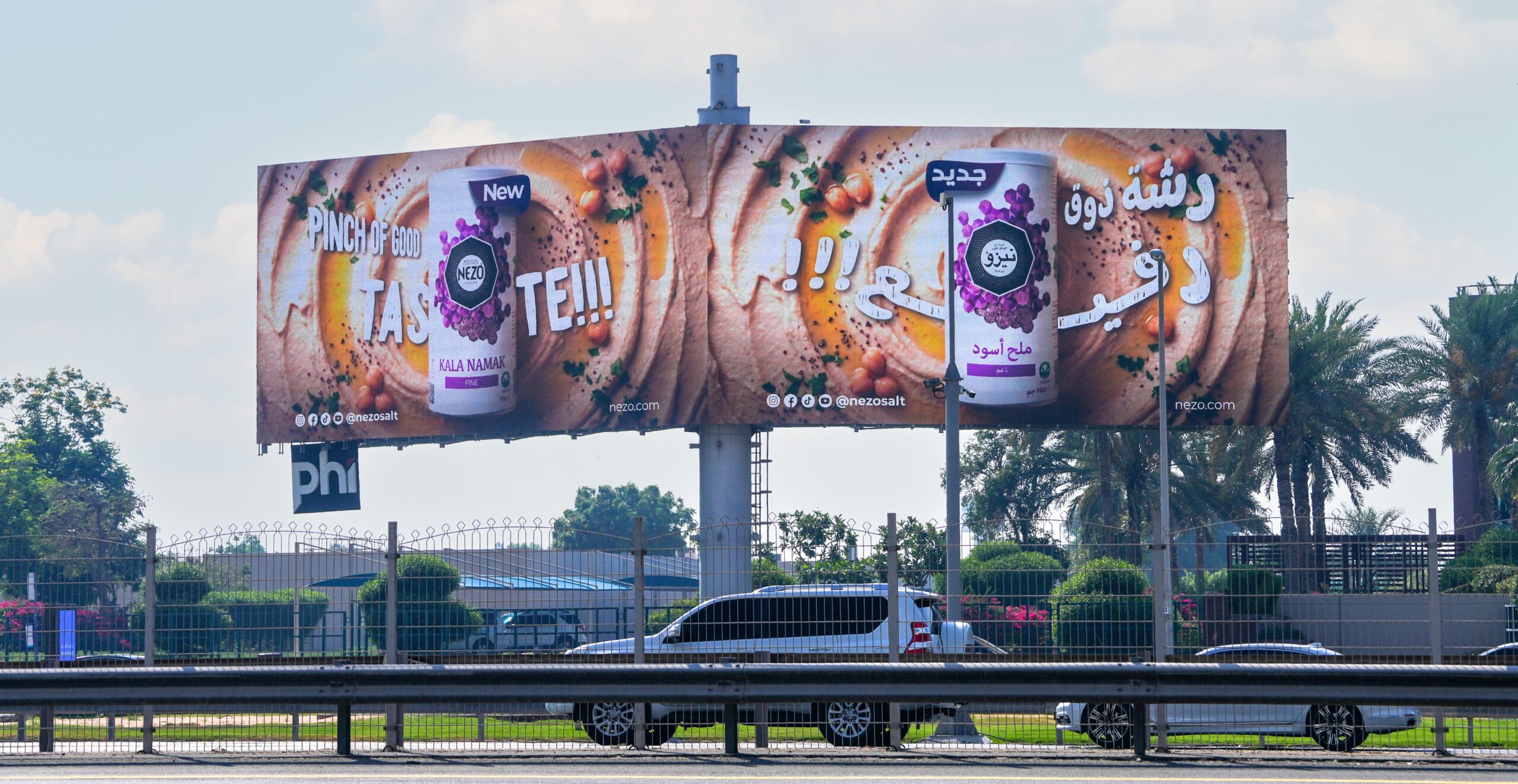
Why 6 Words Beat 16: The Optimal OOH Message Hierarchy
The common challenge with Out-of-Home (OOH) isn’t placement – it’s performance.
Not because the format is ineffective, but because the message delivered isn’t built for the context in which it appears.
In a low-attention environment, clarity beats creativity, and fewer words drive more impact. This is where message hierarchy becomes critical and why, in OOH, six words will almost always outperform sixteen.
The Reality of 3-Second Attention
OOH isn’t browsed, scrolled, or actively consumed. It’s passed, glimpsed, and processed in motion. For roadside formats in particular, dwell time is often measured in seconds – sometimes as little as three.
That fundamentally changes how communication works.
There is no time to read, interpret and evaluate multiple messages. Instead, the brain relies on rapid visual processing – scanning for something it can recognise, understand and store almost instantly.
Research from attention studies such as Lumen Research and Thinkbox shows that attention drops as cognitive effort increases. The more work a message requires, the less likely it is to land.
This creates a simple constraint: if it can’t be understood in seconds, it won’t be understood at all.
Why More Words Reduce Impact
As a high-investment channel, OOH often creates a temptation to say as much as possible within a single execution. More copy and more detail but, as a result, more for consumers to process.
This approach doesn’t increase effectiveness, it dilutes it.
Cognitive science consistently shows that as complexity increases, comprehension decreases. The brain prioritises a single dominant element; when multiple messages compete, none are fully processed.
The 6-Words Principle
‘6 words’ isn’t a rule. It’s a discipline.
A way of forcing prioritisation in a format where attention is limited and time is constrained. Strong OOH is built around a single, clear idea; supported by a visual hierarchy that enables immediate understanding.
This is what enables 3-second comprehension – the ability for a message to be seen, understood and mentally stored almost instantly. Reducing a message to its simplest form forces clarity.
Shorter messages are easier to process and more likely to be encoded into memory.
From Idea to Execution
The challenge isn’t just simplifying a message. It’s translating a broader campaign idea into something that works within the constraints of OOH.
Campaigns are often built around big ideas and layered messaging. While this works across channels with time and interaction, OOH demands compression. That means identifying the single most important takeaway and expressing it in a way that can be understood in seconds.
In practical terms, this means:
• Defining the core message early – not everything the campaign wants to say
• Designing for 3-second comprehension – if it can’t be understood instantly, refine it
• Separate messages across executions – don’t combine multiple ideas into one
• Align with the environment – design for movement, distance and speed
• Use OOH as a trigger – create recognition and recall, don’t force a full explanation.
When this approach is applied, OOH becomes more effective, not by saying more but by making what it says easier to see, process and remember.
The Team Red Dot Takeout
OOH remains one of the most effective ways to achieve scale and visibility, but visibility alone does not guarantee impact.
In an environment defined by movement and limited attention, effectiveness is shaped by how quickly a message can be understood.
That requires discipline.
In OOH, the goal isn’t to say more – it’s to ensure what you say is actually seen, understood and remembered. Which is why fewer words matter more.
“The briefs that perform best in OOH are rarely the ones with the most to say. This medium rewards restraint and the brands embracing that aren’t just easier to see, they’re harder to forget. For OOH copy, less is always more.”
– Aseem Bhandari, Head – Offline Activations, Team Red Dot
References
• Lumen Research (2023–2024). Attention Economy Studies.
• Thinkbox (2022). The Attention Dividend.
• IPA (various studies, 2016–2024). Marketing effectiveness case studies and
analysis.
• Ehrenberg-Bass Institute (various publications, 2010–2024). Research on
distinctive brand assets and memory structures.
• Out of Home Advertising Association of America (OAAA) (2020–2024).
Creative Best Practice Guidelines.
• Nielsen (OOH studies, 2019–2024). Out-of-Home advertising effectiveness
research.
• Cognitive Load Theory – John Sweller (1988)
• Hick’s Law – William Edmund Hick (1952)